UKRAINE STRIKES DEEP! GAZPROM FACILITY ABLAZE
Ukrainian drones ignite one of Russia’s largest gas plants 1,200+ km from front lines — Orenburg facility burns overnight
19/10/2025


Overnight on 19 October 2025, Ukrainian drones struck deep into Russian territory, igniting a major fire at the Orenburg Gas Processing Plant, a critical facility owned by Gazprom.
The Ukrainian General Staff confirmed the attack, which reportedly targeted a key unit of the massive complex.
Since early August, Ukraine has consistently targeted fuel infrastructure across Russia several times a week in a strategic effort to disrupt logistics and reduce revenue streams that support Moscow’s war machine.
Ukrainian forces now strike multiple fuel facilities each week. These repeated attacks have already triggered fuel shortages in several Russian regions, further pressuring the country’s ability to sustain its full-scale invasion.
Ukrainian drones strike deep inside Russia, setting Gazprom’s Orenburg gas plant ablaze
The drone attack hit the Orenburg Gas Processing Plant in Orenburg Oblast, approximately 1,250 km from the Ukrainian border.
Ukrainian Telegram channel Exilenova+ first reported the explosion around 4 a.m., sharing photos of a bright red glow on the horizon. Local messages referenced smoke and fire in the area of the plant.
Shortly after, Supernova+ posted more images, including a screenshot from a local social group confirming the fire.
Additional images and videos of the burning facility were later shared by both channels.
The facility is one of Russia’s largest natural gas processing complexes and a key part of Gazprom’s infrastructure. It produces natural gas, stabilized gas condensate, sulfur, propane–butane mixtures, and other components.
According to Militarnyi, the plant’s declared maximum annual gas processing capacity reaches 40–45 billion cubic meters. It also handles up to 6.2 million tons of gas condensate and oil per year.
Russian Telegram news channel Astra reported that drones attacked the plant and that the strike caused a significant fire.
The governor of Orenburg Oblast, Evgenii Solntsev, confirmed that drones hit the Gazprom facility, stating that part of the infrastructure was damaged and that a fire broke out in one of the plant’s units.
Before the explosions, authorities had issued a drone alert for the region.
Ukraine confirms the Orenburg attack
Later, Ukraine’s General Staff confirmed that the drone attack caused explosions and a large fire on the plant’s territory. Preliminary information indicated that one of the gas treatment and purification units was hit.
The Ukrainian military emphasized that the facility plays a role in supporting Russia’s military needs and is part of its broader campaign to degrade critical infrastructure involved in sustaining the Russian war effort.
The General Staff also confirmed successful strikes on two other targets the same night: Rosneft’s Novokuybyshevsk oil refinery in Samara Oblast and a fuel and lubricant depot in Russian-occupied Berdiansk on the coast of the Sea of Azov.
Russia’s Defense Ministry claimed it destroyed 45 Ukrainian drones overnight, including one allegedly in Orenburg Oblast.
Update: Orenburg Gas Plant halts intake of Kazakhstan gas after last night’s attack
Kazakhstan’s Energy Ministry said that Russia’s Orenburg Gas Processing Plant has temporarily stopped receiving raw gas from the Karachaganak field in northern Kazakhstan.
It cited Gazprom’s statement, saying the stoppage was caused by an emergency situation resulting from a drone attack.
The extent of the damage and the timeline for resuming operations have not yet been provided by the Russian side.
Subscribe



Today’s Birthday
-
Jean-Paul Sartre (1905)June 21, 2026
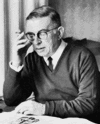 Sartre was a French philosopher, playwright, and novelist who became the foremost exponent of existentialism in the 20th century. His first novel, Nausea, was one of many works depicting man as a lonely being burdened with a terrifying freedom. He served in World War II, was taken prisoner, escaped, and was involved in the French resistance, during which he wrote multiple works. In 1964, he became the first person to voluntarily decline the Nobel Prize in Literature. Why did he refuse it?
 Sartre was a French philosopher, playwright, and novelist who became the foremost exponent of existentialism in the 20th century. His first novel, Nausea, was one of many works depicting man as a lonely being burdened with a terrifying freedom. He served in World War II, was taken prisoner, escaped, and was involved in the French resistance, during which he wrote multiple works. In 1964, he became the first person to voluntarily decline the Nobel Prize in Literature. Why did he refuse it?
Today’s Holiday
-
National Aboriginal DayJune 21, 2026
.jpg) Long before a national holiday was established, this day of the year had been observed by Canada's Inuit, Métis, and First Nations peoples as a celebration of Aboriginal heritage. In 1996, the Canadian government made June 21 an official holiday, including all citizens in the observance. Celebrations take place throughout Canada, and are organized by the regional offices of Indian and Northern Affairs Canada and Canadian Heritage. Some festivities are modest celebrations; others exhibit a stronger focus on culture and tradition by holding canoe races, powwows, and awareness events.
Long before a national holiday was established, this day of the year had been observed by Canada's Inuit, Métis, and First Nations peoples as a celebration of Aboriginal heritage. In 1996, the Canadian government made June 21 an official holiday, including all citizens in the observance. Celebrations take place throughout Canada, and are organized by the regional offices of Indian and Northern Affairs Canada and Canadian Heritage. Some festivities are modest celebrations; others exhibit a stronger focus on culture and tradition by holding canoe races, powwows, and awareness events.
.jpg) Long before a national holiday was established, this day of the year had been observed by Canada's
Long before a national holiday was established, this day of the year had been observed by Canada's ARTICLE OF THE DAY
-
CigarsJune 21, 2026
 Cigars, tightly rolled bundles of cured tobacco, were being smoked by the Mayans as early as the 10th century. Spanish travelers to the Americas brought cigars back to Spain in the 16th century, and their popularity then spread throughout Europe. The word cigar, therefore, derives from the Mayan word for tobacco. What did US President John F. Kennedy reportedly do immediately before imposing the Cuban trade embargo that, among other things, prohibits US residents from purchasing Cuban cigars?
 Cigars, tightly rolled bundles of cured tobacco, were being smoked by the Mayans as early as the 10th century. Spanish travelers to the Americas brought cigars back to Spain in the 16th century, and their popularity then spread throughout Europe. The word cigar, therefore, derives from the Mayan word for tobacco. What did US President John F. Kennedy reportedly do immediately before imposing the Cuban trade embargo that, among other things, prohibits US residents from purchasing Cuban cigars?
Leave a Reply
You must be logged in to post a comment.